By: Elizabeth Rakow
Published On: 1/30/2026
Updated On: 6/2/2026
WE TRIED IT:
The At-Home Pilates Reformer
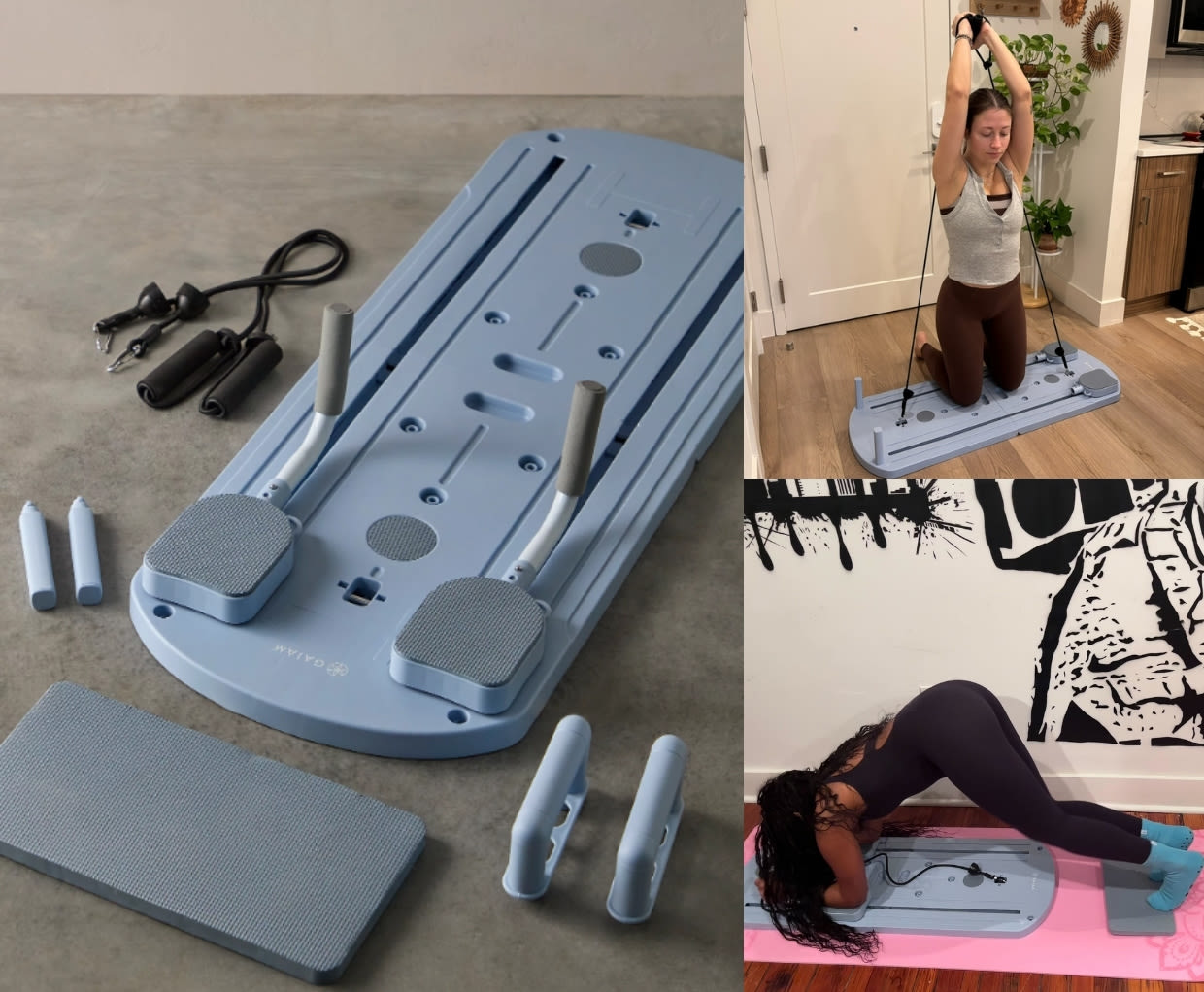
So…can you really get a studio-quality workout at home?
We were determined to find out. As January’s blustering cold continues to build and our motivation continues to dwindle, this month’s We Tried It was all about finding a new way to workout...preferably one that doesn’t include leaving the house. Enter: The Gaiam Pilates At-Home Reformer, a just-in piece of exercise equipment that Team FP Movement was dying to test out.
The Benefits of At-Home Pilates Reformer Workouts
The way we see it, working out from home can be a hit-or-miss experience. For some, it’s easier to motivate yourself when the barrier to entry is a little lower. Rise from the couch, throw on your favorite set, and proceed with 30-45 minutes of activity. For others, that exact barrier raises the stakes and actually makes them more inclined to follow through. Sign up for the class or gym membership, strap on your gear, and get moving (so you don’t lose out on whatever you paid for said class or gym membership). Either way: we get it. But this We Tried It is all about looking at the at-home workout as a beneficial experience, so let’s talk about the pros of working out in your own space, specifically with an at-home reformer.
Full-Body Workout
A Pilates reformer offers opportunities for strength building, deep core engagement, and improved flexibility. Not only does it offer scalable resistance and a truly customizable workout, it also targets smaller stabilizing muscles that can often be missed in more traditional forms of exercise.
Your Schedule, Your Terms
No class schedules to contend with, no commute to the studio, and no prescribed time limit that you’re forced to adhere to. With an at-home reformer, your time is your own. Plus, there are countless virtual classes, instructors, and styles that you can find with a simple search.
More Cost Effective
A typical Pilates class can be up to $50 per session, which definitely adds up over time. By investing in an at-home reformer, you’re saving money in the long term and creating a totally customized routine that can be updated with any and all life changes.
Full-Body Workout
A Pilates reformer offers opportunities for strength building, deep core engagement, and improved flexibility. Not only does it offer scalable resistance and a truly customizable workout, it also targets smaller stabilizing muscles that can often be missed in more traditional forms of exercise.
Your Schedule, Your Terms
No class schedules to contend with, no commute to the studio, and no prescribed time limit that you’re forced to adhere to. With an at-home reformer, your time is your own. Plus, there are countless virtual classes, instructors, and styles that you can find with a simple search.
More Cost Effective
A typical Pilates class can be up to $50 per session, which definitely adds up over time. By investing in an at-home reformer, you’re saving money in the long term and creating a totally customized routine that can be updated with any and all life changes.
WHAT WE DID + HOW WE MOVED
Tested out by two women who know their way around a reformer, the Gaiam was put to the test by Jackie, a member of the FP Movement Merchandising team and a Core Power instructor, and Misa, a member of the Free People Merchandising team and a SolidCore instructor. We’ll let them take it from here:
Jackie: “I did pretty much a full body workout. The exercises I did are: lateral lunges and reverse lunges, which works the glutes, quads, calves, and hamstrings, overhead tricep extensions, which works triceps, wide arm bicep curls, and front raises, which work the biceps and shoulders. I also did some mountain climbers, plank holds, and plank crunches, which work the transverse abdominals (top and bottom abs and obliques) and shoulders. I finished off with some push ups to work my chest and core”
Misa: “I used the reformer primarily for center exercises: a plank hold, cat/cow or prone crunch, and sliding plank extensions. These exercises mostly targeted my transverse abdominal muscles by adding instability through sliding or extending. The rectus abdominis was the muscle focus in the prone crunches / cat cows.”
Jackie: “I did pretty much a full body workout. The exercises I did are: lateral lunges and reverse lunges, which works the glutes, quads, calves, and hamstrings, overhead tricep extensions, which works triceps, wide arm bicep curls, and front raises, which work the biceps and shoulders. I also did some mountain climbers, plank holds, and plank crunches, which work the transverse abdominals (top and bottom abs and obliques) and shoulders. I finished off with some push ups to work my chest and core”
Misa: “I used the reformer primarily for center exercises: a plank hold, cat/cow or prone crunch, and sliding plank extensions. These exercises mostly targeted my transverse abdominal muscles by adding instability through sliding or extending. The rectus abdominis was the muscle focus in the prone crunches / cat cows.”
WHAT WE THOUGHT
So…what did we think of the reformer?
Jackie: “Overall I do think this would be better for someone who is more of a beginner, because they will just be getting used to doing these moves. When I take a reformer class, I typically use a mid-high resistance to challenge myself more, but this does not allow for added resistance and I think that would be the most important thing to make this a better option for people who use reformers often. However, it offers a variety of workouts to target many different muscle groups and it’s portable and lightweight so can bring it with you to the gym or on-the-go. Very easy and intuitive to assemble!”
Misa: “I thought it was a great supplementary reformer option for at home. For me it would be a nice way to practice form, focus on core, and find some low pressure at-home movement. I didn't see myself getting an intense sweaty workout at home, but that is what I liked about it. Since I'm someone that regularly takes + coaches high intensity megaformer classes, I'm always looking for ways to incorporate some of those workouts at home without it feeling like a daunting physical challenge.”
What about home workouts in general?
Jackie: “I 100% prefer to workout in a studio with a guided instructor and other people in class. It’s just much more motivating to me personally. Working out at home is good for people who want to be more private and are a little more shy to step into a gym/studio, but I find it really helpful to have someone guiding you and telling you how to do specific workouts.”
Misa: “I find it hard to workout at home. I find I need to leave my house for a scheduled workout time to actually get myself to workout. I will say, the size of this reformer is just perfect for small spaces. I used it right at my desk and downstairs in the living room. Highly recommend using a mat under it to keep it from sliding!”
Jackie: “Overall I do think this would be better for someone who is more of a beginner, because they will just be getting used to doing these moves. When I take a reformer class, I typically use a mid-high resistance to challenge myself more, but this does not allow for added resistance and I think that would be the most important thing to make this a better option for people who use reformers often. However, it offers a variety of workouts to target many different muscle groups and it’s portable and lightweight so can bring it with you to the gym or on-the-go. Very easy and intuitive to assemble!”
Misa: “I thought it was a great supplementary reformer option for at home. For me it would be a nice way to practice form, focus on core, and find some low pressure at-home movement. I didn't see myself getting an intense sweaty workout at home, but that is what I liked about it. Since I'm someone that regularly takes + coaches high intensity megaformer classes, I'm always looking for ways to incorporate some of those workouts at home without it feeling like a daunting physical challenge.”
What about home workouts in general?
Jackie: “I 100% prefer to workout in a studio with a guided instructor and other people in class. It’s just much more motivating to me personally. Working out at home is good for people who want to be more private and are a little more shy to step into a gym/studio, but I find it really helpful to have someone guiding you and telling you how to do specific workouts.”
Misa: “I find it hard to workout at home. I find I need to leave my house for a scheduled workout time to actually get myself to workout. I will say, the size of this reformer is just perfect for small spaces. I used it right at my desk and downstairs in the living room. Highly recommend using a mat under it to keep it from sliding!”
"It offers a variety of workouts to target many different muscle groups and it’s portable and lightweight so can bring it with you to the gym or on-the-go.”
WHAT WE WORE
We’d be remiss not to give a shoutout to the reformer-friendly FP Movement styles that made their appearance while we tried the reformer.
The Tighten Up Reversible Bra: Designed for low-impact workouts, this soft-stretch sports bra offers light compression with a comfortable, ribbed fabrication. Plus, it features a striped side and a solid side so you can wear it more ways than one.
The Quick Step Pant: Sweat-wicking, breathable, and made with four-way stretch, these workout pants are an effortless substitute for your most worn-in leggings. A fresh silhouette with all the features needed for your sweatiest workouts.
The Never Better 7/8 Length Leggings: Core, classic, and comfortable, our Never Better collection was named for a reason. These leggings offer a buttery soft feel, keep you dry and comfortable while you sweat, and feature a stay-put fit for distraction-free workouts anytime, anywhere.
The Power House Pilates Grip Socks: Whether you’re working the at-home reformer or taking it to the mat, these so-cute Pilates socks offer a staple crew style with a grippy bottom made for enhanced stability on any surface.
The Tighten Up Reversible Bra: Designed for low-impact workouts, this soft-stretch sports bra offers light compression with a comfortable, ribbed fabrication. Plus, it features a striped side and a solid side so you can wear it more ways than one.
The Quick Step Pant: Sweat-wicking, breathable, and made with four-way stretch, these workout pants are an effortless substitute for your most worn-in leggings. A fresh silhouette with all the features needed for your sweatiest workouts.
The Never Better 7/8 Length Leggings: Core, classic, and comfortable, our Never Better collection was named for a reason. These leggings offer a buttery soft feel, keep you dry and comfortable while you sweat, and feature a stay-put fit for distraction-free workouts anytime, anywhere.
The Power House Pilates Grip Socks: Whether you’re working the at-home reformer or taking it to the mat, these so-cute Pilates socks offer a staple crew style with a grippy bottom made for enhanced stability on any surface.
MORE FOR YOUR AT-HOME WORKOUTS
MORE TO READ
1/23/26 | STARTING STRONG:
Why Creatine Could Be Your New Strength Staple
We’re off to a strong start in 2026…and you can be too.
12/12/25 | FITNESS FILES
The 12 Days of Movement
On the second week of Christmas, FP Movement gave to me…12 ways to get up, get out there, and get moving!
10/1/25 | WORTH THE WEIGHT
We Wore a 10-Pound Vest for 2 Weeks
A diary-style breakdown with nothing but the weight of our own expectations (and, of course…our vests).
Frequently Asked Questions on At-Home Pilates Reformer Workouts
What muscles do at-home reformer workouts target?
These workouts primarily engage your core (including deep abdominals and back muscles) while also strengthening glutes, hips, shoulders, and legs. The controlled movements help build strength, stability, and flexibility all at once, targeting smaller stabilizing muscles that traditional exercises often miss.
Is an at-home reformer suitable for beginners?
Absolutely! Our compact reformer is designed with beginners in mind, offering a gentle introduction to reformer-style movements. Just move slowly, focus on proper form, and start with shorter sessions to build strength and body awareness before progressing.
How much space do I need for an at-home reformer workout?
You'll need enough room to lie down fully and move your arms and legs freely (basically, a yoga mat's worth of space). We recommend clearing a flat, non-slip surface with a few feet of clearance around you and placing a mat underneath to keep everything stable.
How often should I practice Pilates to see results?
Consistency is key! Many people notice improvements in strength and posture with 2–4 Pilates sessions per week. We love alternating reformer days with rest or lighter movement to support recovery and keep your body balanced.
Can I get a studio-quality Pilates workout at home?
While a compact Pilates reformer offers similar resistance patterns and core engagement as studio equipment, it's best for light to moderate resistance and learning foundational moves. It's a wonderful way to practice form, focus on your core, and enjoy low-pressure movement without leaving home.
What should I wear for at-home reformer workouts?
We recommend soft-stretch, low-impact pieces that move with you—think comfortable sports bras, breathable leggings with four-way stretch, and grippy Pilates socks for enhanced stability. Choose styles that keep you dry and distraction-free so you can focus on your flow.
Do I need extra equipment besides the Pilates reformer?
A thick mat adds comfort, especially for kneeling exercises. You might also enjoy small props like light hand or ankle weights, blocks, or a Pilates ball if your routine calls for them, but the reformer itself is a great starting point.
How can I follow along with guided workouts at home?
Look for video classes, digital workouts or detailed exercise guides that walk you through sequences step by step. Following an instructor helps you maintain proper alignment, find the right resistance, and keep your practice varied and effective.